
A holistic ESG strategy not only addresses global challenges but is also the key to unlocking new business opportunities and enhancing long-term competitiveness. ESG thus becomes a key driver of value creation and preservation and, therefore, a critical factor for future viability in an increasingly sustainability-focused economy.
ESG Solutions for sustainable, successful Companies
What does ESG mean, and what criteria are involved?
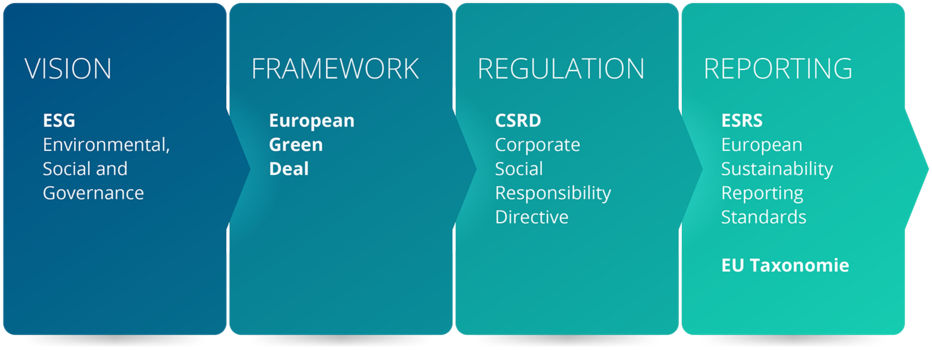
ESG stands for Environmental, Social and Governance. These three criteria serve as a benchmark for evaluating the sustainability performance of a company or organization. Investors use these criteria to select companies and projects that are not only financially profitable but also have a positive social and environmental impact and demonstrate responsible corporate governance.
Within the framework of the European Green Deal, ESG and sustainable finance play a crucial role in achieving the goals of climate neutrality and a resource-efficient economy.

Sustainability Services & Sustainability
Measures and efforts in the areas of sustainability and corporate social responsibility have long been—and not just since the EU’s Green Deal—the standard by which businesses are evaluated and developed. In addition to the requirement to implement climate and environmental protection measures in compliance with the law, reporting provides an expanded basis for assessment by stakeholders and facilitates the implementation of climate and environmental protection measures to ensure competitiveness.
ICON advises you on implementing the “Green Transformation” in your company, thereby ensuring maximum added value for your company’s development.

At the same time, the Austrian federal government has introduced a national CO2-Steuer tax as part of its eco-social tax reform. These new regulations particularly affect market participants such as manufacturers and suppliers of energy products. However, these provisions are also of central importance for energy- and emissions-intensive industries as consumers of energy products. These industries face a massive increase in energy costs and, consequently, in production and manufacturing costs. This raises the question, in particular, under what conditions a reimbursement of the CO2CO2 tax is possible. Our experts are happy to assist you with the implementation and optimization of green taxation.
We advise you on the following topics
- Green Benefits & Social Benefits: Introduction and evaluation of tax-advantaged and sustainable benefits for your employees (e.g., Klimaticket, Jobrad, company transportation models, etc.)
- Energy Taxation (e.g., CO2 tax, energy taxes, CO2border adjustment mechanism)
- Plastic Tax/Packaging Taxes for Projects Within the EU
- Assessment of the Specific Impacts on Your Company and Potential Optimization Measures
- Support Regarding Compensation Options for Companies (e.g., carbon leakage, hardship relief measures)
- Support services related to reporting and disclosure requirements
- Interaction with existing energy taxes (e.g., mineral oil tax)
- Impact on other tax areas (e.g., transfer pricing/corporate income tax)

Despite changes in regulations, the importance of sustainability reporting continues to grow for companies and stakeholders. The regulatory framework includes, among other things, the Corporate Sustainability Reporting Directive (CSRD) and the EU Taxonomy Regulation.
The Corporate Sustainability Reporting Directive (CSRD) has expanded companies’ reporting obligations regarding sustainability issues. In accordance with the directive, the first companies were required to comply as early as the 2024 fiscal year. Since national implementation in Austria has not yet been finalized, the reporting obligation will not take effect until the 2026 fiscal year.
The focus is on the following aspects:
- Expansion of reporting obligations
- Sustainability reporting as a mandatory component of the management report
- Requirement to apply European Sustainability Reporting Standards (ESRS)
- Audit requirement for sustainability reporting
In addition, reporting in accordance with the IFRS Sustainability Disclosure Standards may result in further reporting obligations.
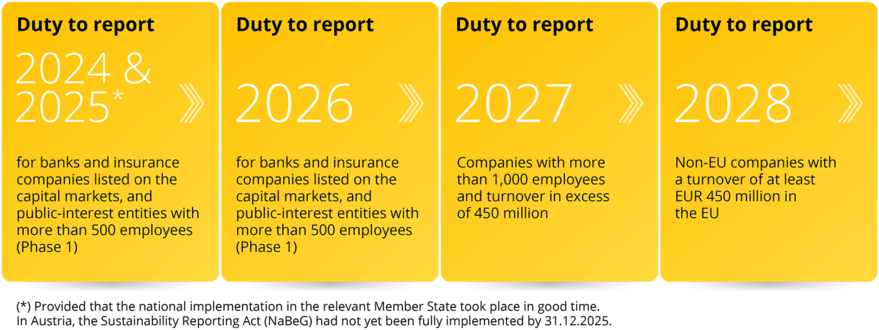
Companies subject to the CSRD are required to report information and content related to ESG categories in accordance with uniform EU standards (ESRS). The required disclosures must be included in the management report. This is intended to ensure consistency and comparability among the reports.
We provide advice on the following topics from an audit perspective
- Design of non-financial reporting (structures & processes)
- Materiality analysis and stakeholder survey
- Audit of sustainability reporting
The new sustainability reporting requirements undoubtedly pose a major challenge for companies. The sooner and more thoroughly a company addresses this issue, the faster it will recognize the opportunities and benefits of capitalizing on capital market participants’ growing awareness of sustainability issues.
Mag. Vrba Maria
Specialisation
- Audit
- Special Audit
- Due Diligence
- National and International Financial Reporting
- Filing with the Commercial Register
- ESG expert
Functions
- Member of iwp Institute of Austrian Auditors
- Lecturer
- Author
Qualifications | Awards
- Certified Business Mediator